Sell a Condemned House in Washington: 2026 Demolition & Cash Buyer Options
Yes, you can sell a condemned house in Washington. Here is how RCW 35.80 condemnation, demolition liens, and as-is cash sales actually work in 2026.
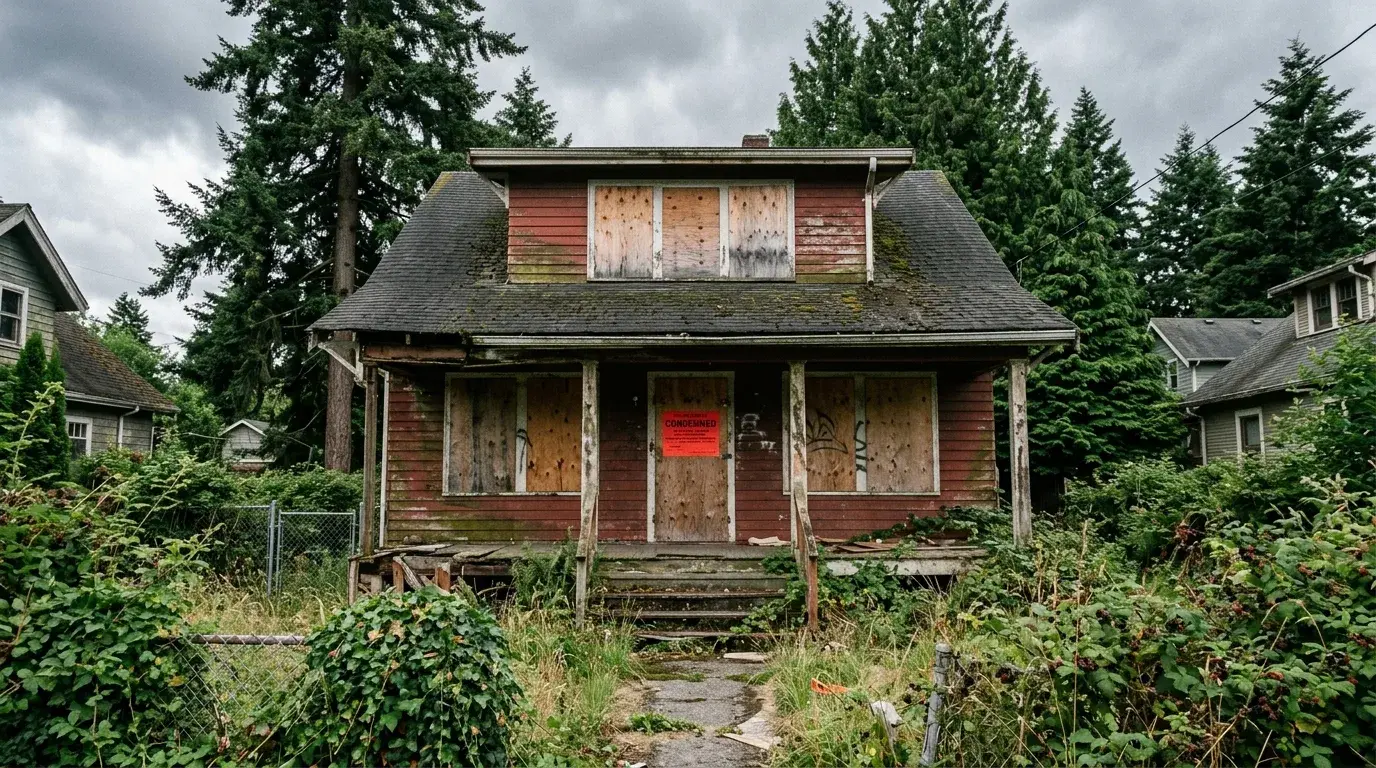
Yes, you can sell a condemned house in Washington — and you do not have to fix it, demolish it, or even clean it out before closing. The condemnation order restricts who can live in the structure, not who can own it. The catch is that traditional mortgage lenders will not touch a condemned dwelling, which collapses your buyer pool down to cash investors, demolition-and-rebuild developers, and the occasional neighbor who wants the lot.
This guide covers how Washington's condemnation process actually works under RCW 35.80 and RCW 35.82, what municipal demolition liens look like in Seattle, Tacoma, Olympia, and Bellingham, when a condemnation can be reversed, and the realistic cash-buyer process for red-tagged properties across the Pacific Northwest. If your house was condemned because of fire damage, water damage, or accumulated code violations, the path to closing is faster than most homeowners expect.
The short version: A condemnation order in Washington establishes the structure as unfit for occupancy under municipal code. Disclosure is required on Form 17 under RCW 64.06.020. Demolition liens recorded under RCW 35.80.030 must be paid at closing or assumed by the buyer. Cash buyers — here is how those offers actually work — close in 10 to 21 days without lender involvement, which is the only realistic path for most condemned properties.
What Condemnation Actually Means in Washington
In everyday speech "condemned" gets used loosely, but Washington law treats it as a specific legal status. A property is condemned when a city, county, or health department has issued an official order declaring the structure unfit for human occupancy. The most common statutory frameworks are:
The label most homeowners actually see is the red placard or "red tag" posted on the front door by the building or health department. That placard is the physical signal of a Notice and Order — a written demand requiring the owner to repair, vacate, or both, by a specific deadline. If the owner does not comply, the city can escalate to a hearing, an order to demolish, and ultimately court-supervised abatement.
Condemned vs Red-Tagged vs Uninhabitable
These terms get used interchangeably but they are not the same thing.
If you have a fire-damaged house, water-damaged structure, or home with mold and water damage, you may be in red-tag territory without a formal condemnation. The selling path is similar but the disclosure obligations and lien exposure differ.
How the Washington Condemnation Process Works
The process typically takes 30 to 180 days from initial complaint to formal condemnation, depending on the city, the severity of the conditions, and the owner's response. Here is how it generally moves under RCW 35.80:
1. Complaint or inspection trigger. Most cases start with a neighbor complaint, a 911 fire response, a utility shutoff request, or a code enforcement sweep. The building department sends an inspector. 2. Initial inspection and red tag. If the structure is found unsafe for occupancy, the inspector posts a placard and notifies any occupants to vacate. 3. Notice and Order issued. Mailed and posted within days. Lists specific violations, cites code sections, and establishes the compliance deadline (often 30 to 60 days). 4. Hearing rights. Under RCW 35.80.030, the owner has the right to request a hearing before the city's hearings examiner. If you miss the deadline to request a hearing, the order becomes final. 5. Compliance window. The owner repairs, demolishes, or appeals. If nothing happens, the city moves to enforcement. 6. Final condemnation order. The hearings examiner or city council confirms the property is unfit and authorizes abatement — repair by city contractor or demolition. 7. Abatement. The city executes the order. Costs are assessed against the property and recorded as a lien.
Pro Tip: The earliest stages of this process are reversible. If you receive a Notice and Order, you have the right to request a hearing in writing — almost every Washington jurisdiction requires the request within 10 to 30 days of the notice. Missing that window is what most distressed homeowners regret. Even if you do not plan to repair, requesting the hearing buys time to sell the property before the city files a demolition lien.
When a Condemnation Order Can Be Reversed
Reversal is possible when the underlying conditions are repairable and the owner can fund the work. Washington jurisdictions generally lift a condemnation order after:
Reversal is typically NOT available when:
For most distressed sellers reading this guide, repair is not financially realistic. That is why the cash sale path exists.
Demolition Costs in Washington: Seattle, Tacoma, Olympia, Bellingham
If you keep the property and demolish, or if a buyer plans to demolish post-sale, the cost matters because it directly affects offer prices on condemned land. Here are realistic 2026 ranges for residential demolition across the Pacific Northwest, based on permit data and contractor quotes commonly seen across King, Pierce, Thurston, and Whatcom counties.
| City | Typical Single-Family Demo | Asbestos Abatement Add | Permit & Survey Fees | |------|---------------------------|------------------------|---------------------| | Seattle | $18,000 – $25,000 | $5,000 – $15,000 | $1,500 – $3,000 | | Tacoma | $13,000 – $19,000 | $4,000 – $12,000 | $800 – $1,800 | | Olympia | $12,000 – $17,000 | $4,000 – $10,000 | $700 – $1,500 | | Bellingham | $13,000 – $18,000 | $4,000 – $11,000 | $800 – $1,600 | | Spokane | $11,000 – $16,000 | $3,500 – $9,000 | $600 – $1,400 |
Several factors push the upper end of the range:
For a typical pre-1980 Seattle home, total demolition cost commonly lands in the $25,000 to $40,000 range when asbestos and permit work are included. Tacoma and Olympia run materially cheaper because of lower tipping fees, less restrictive tree codes, and faster permit cycles.
Municipal Demolition Liens and How They Get Paid
This is the part that surprises most homeowners. If the city demolishes the property under RCW 35.80.030, the cost does not simply vanish — it becomes a lien against the property with priority similar to a property tax lien.
Here is how the lien sequence typically works:
In King County, demolition liens recorded by the City of Seattle under SMC 22.206 are frequently in the $30,000 to $60,000 range when administrative costs and interest are included. In Pierce, Thurston, and Whatcom counties, liens tend to run lower — often $20,000 to $40,000 — but still represent a significant payoff at closing.
Important: A buyer purchasing your property has three options when a demolition lien exists.
1. Require the seller to pay the lien at closing through escrow, reducing seller proceeds 2. Assume the lien at a reduced purchase price (taking the property "subject to" the lien) 3. Negotiate with the city for a settlement or partial payoff (rare and slow)
Most cash investors do option 1 or 2 depending on the math. If lien amounts exceed land value, the deal often dies — which is why timing matters. Selling before the city demolishes preserves more equity for the seller.
The Cash Buyer Process for Condemned Properties
Selling a condemned or red-tagged house to a cash buyer is structurally simpler than a traditional sale because there is no lender to satisfy. Here is the realistic step-by-step.
Step 1: Pull Documents and Calculate Real Position
Before you talk to any buyer, gather:
This stack tells you and the buyer exactly where the property stands legally. Buyers offering on condemned property without seeing the Notice and Order are guessing — a serious cash buyer will ask for the documents up front.
Step 2: Understand Your Bottom Line
Your net at closing will be:
After-repair land or rebuild value × (cash buyer offer percentage) − repair/demolition costs assumed by buyer − liens and back taxes − closing costs − existing mortgage payoff
Cash buyers typically offer 60 to 80 percent of after-repair or rebuild value depending on demolition risk, lien exposure, and lot demand. In Seattle's hot teardown markets (Ballard, Capitol Hill, West Seattle), strong lots clear at the top of that range. In Tacoma's Hilltop, Olympia, and outer Whatcom County, demolition risk weighs more heavily on the offer.
Step 3: Get Multiple Offers, Verify the Buyer
Get at least three offers. Verify each buyer:
Avoid wholesalers who tie up the property under contract and then shop the deal. A direct cash buyer closes with their own funds.
Step 4: Disclosure on Form 17
Even on a clearly condemned property, you must complete Form 17 under RCW 64.06.020. Disclose the condemnation order, any code violations, fire/water damage, asbestos knowledge, environmental issues, and known liens. The condemnation order itself is the strongest possible disclosure — there is no upside to hiding it. Buyers will see it in title work anyway.
Step 5: Title and Escrow
The title company will:
For condemned properties, expect title work to take 5 to 10 business days because of the additional municipal payoff requests.
Step 6: Closing
Cash closings on condemned properties typically take 10 to 21 days from accepted offer. The seller usually does not need to be on site — Washington allows mail-away closings with notarized documents. You receive net proceeds at closing via wire or certified check.
If you are juggling multiple distressed-property issues — say, a condemnation overlapping with delinquent property taxes, code violations, or a pending foreclosure — the cash sale path is usually the only one fast enough to close before the situation gets worse.
Tax Implications of Selling a Condemned Property
Most distressed homeowners assume a low-dollar sale on a condemned property has no tax consequences. That is sometimes true and sometimes very wrong. Three issues come up regularly:
A 30-minute call with a Washington-licensed CPA or tax attorney before closing usually pays for itself. Do not rely on the buyer or the title company for tax advice — neither has the duty or expertise to give it.
Common Scenarios That End in Condemnation
Most condemnation cases trace back to one of a few patterns. Recognizing where you are helps you choose the right path.
Frequently Asked Questions
Can a condemned house be sold without demolition?
Yes. The condemnation order does not require demolition unless the city has issued a specific demolition order. Many condemned houses are sold as-is to cash buyers who either repair them back into compliance or demolish on their own timeline. The transfer of ownership does not depend on the structural work being complete.
Will a condemned property show up on title?
A formal Notice and Order, condemnation order, or recorded demolition lien will appear in the public record and be picked up by a title search. Red-tag placards alone are typically not recorded but will be flagged by the city when the title company runs municipal lien searches.
What if my mortgage is more than the cash offer?
This becomes a short sale or a deficiency situation. Your lender must approve the sale at the reduced price, which adds 30 to 90 days to the timeline and typically requires hardship documentation. Some Washington lenders waive the deficiency on short sales of condemned properties; others do not. A real estate attorney is worth the consult before signing.
Can I sell the lot separately if the house is condemned?
Generally no — the structure and lot are typically a single legal parcel. You sell the parcel as-is, and the buyer decides whether to repair or demolish. In rare cases where a lot can be subdivided cleanly, splitting may be possible but takes months and rarely improves seller economics on a distressed sale.
How does selling a condemned house differ between Seattle and Tacoma?
The legal framework under RCW 35.80 is identical. The differences are practical: Seattle's land values support higher cash offers even after large demolition liens, Seattle's permit and abatement costs are higher, and the Seattle market has a deeper pool of teardown-experienced buyers. Tacoma offers move faster in lower-tier neighborhoods because demolition is cheaper and lot demand is more uniform. Olympia and Bellingham fall between the two.
What to Do This Week If You Own a Condemned House
If you own a condemned or red-tagged property in Washington and you want it sold, the next seven days are the highest-leverage window.
A cash sale closes faster than the city's demolition machinery moves in almost every case. The mistake distressed homeowners make is waiting for the city to act first.
If you need an honest conversation about what your specific Washington property would clear in its current condition — including condemned, red-tagged, fire-damaged, or pending demolition — request a no-obligation cash offer here. We close on properties most buyers won't touch, including condemned homes across Seattle, Tacoma, Olympia, Bellingham, Spokane, and the broader Pacific Northwest.