How to Sell a House with Delinquent Property Taxes in Washington (2026 Guide)
Sell a house with delinquent property taxes in Washington before the county tax sale: RCW 84.64 timeline, lien priority, payoff at closing, and cash options.
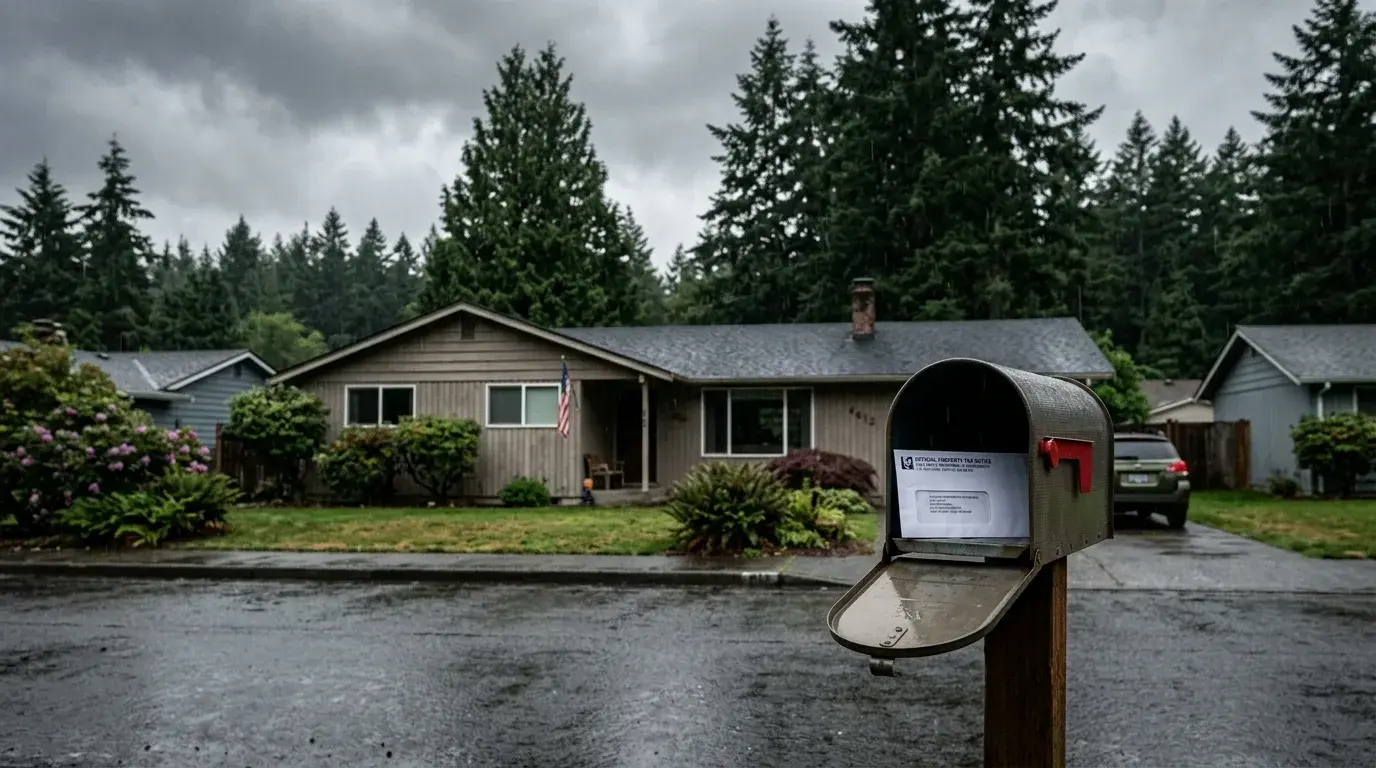
If you owe back property taxes on a Washington home, you can still sell — and as long as your sale closes before the county's annual tax foreclosure auction, the unpaid taxes simply get paid off at closing through escrow, the same way a mortgage does. You do not need the cash up front, you do not need to "catch up" the taxes before listing, and the title transfers free and clear once the treasurer is paid.
The timing is what matters. Washington counties begin tax foreclosure proceedings after taxes have been delinquent for three years, and the actual auction happens once a year (usually in November or December). Miss that deadline and the home is sold to the highest bidder with no redemption period afterward. This guide walks through the full RCW 84.64 timeline, the lien priority math, the realistic options at each stage, and when a direct cash sale beats the alternatives.
> Important: Property tax delinquency is a YMYL situation with real legal and financial consequences. This guide explains the Washington framework in plain language, but it is not legal or tax advice. If you are facing tax foreclosure, consult a Washington-licensed real estate attorney before making decisions. A free starting point is the Washington State Bar Association's lawyer referral service or a HUD-approved housing counselor at 1-877-894-HOME.
The Short Version: How to Sell a House with Delinquent Property Taxes in Washington
A Washington homeowner with delinquent property taxes has more runway than most realize. Here is the compressed answer:
The rest of this article unpacks each of those points so you can see exactly where you are in the timeline and what your realistic options look like.
How Property Tax Delinquency Works in Washington
Washington property taxes are administered at the county level by the county treasurer and assessor. Bills are issued in February for the calendar year, and payment is due in two halves: April 30 for the first half and October 31 for the second half. Miss either deadline and the unpaid amount immediately becomes "delinquent," even if the rest of the year's taxes are paid current.
Washington's interest and penalty structure under RCW 84.56.020 is more aggressive than most homeowners expect:
The arithmetic gets ugly fast. A homeowner who falls a full year behind on a $5,000 tax bill is already looking at roughly $5,000 plus 12% interest plus the 11% in combined penalties — close to $6,150 at the end of year one. By year three, with compounding interest and additional annual penalties on each year's unpaid taxes, the original $5,000 can balloon to nearly $20,000 owed.
For a deeper picture of how distressed-property carrying costs accumulate, our breakdown of the foreclosure timeline in Washington walks through the parallel math on mortgage delinquency.
RCW 84.64 — The Washington Tax Foreclosure Timeline
The full statutory framework for property tax foreclosure in Washington lives in Chapter 84.64 RCW. Here is the timeline as it actually plays out, year by year.
Year 1 — First Year of Delinquency
You miss the April 30 first-half due date or the October 31 second-half due date. Interest starts accruing at 1% per month on day one. The county treasurer mails delinquent notices. You can pay at any time and the only consequence is the interest and penalties — nothing legal happens yet.
This is the cheapest moment to fix the problem. Most county treasurers will accept partial payments and many offer formal payment plans for delinquent taxpayers. Call the treasurer directly. Do not wait.
Year 2 — Continued Delinquency
Year-two interest and penalties stack on top of year one. Some counties will publish lists of delinquent taxpayers in legal notices. The treasurer cannot yet file for foreclosure, but the door is closing.
Year 3 — Certificate of Delinquency Eligibility
Three years from the original delinquency date, the county treasurer becomes legally authorized under RCW 84.64.050 to file a Certificate of Delinquency in superior court. Filing the certificate begins the formal tax foreclosure proceeding.
> Pro tip: The "three years delinquent" trigger is calculated from the original due date of the oldest unpaid installment, not from the most recent unpaid bill. If your April 2023 first-half payment is still unpaid as of May 2026, the county can file a Certificate of Delinquency that summer.
After Filing — The Foreclosure Notice Window
Once the Certificate of Delinquency is filed, the treasurer must:
1. Mail notice to the property owner, occupants, and any party with a recorded interest (lenders, lienholders). 2. Publish notice in a newspaper of general circulation in the county. 3. Wait at least 30 days from the latest of those notices before applying to the court for judgment.
The court then issues a judgment authorizing the sale. The treasurer schedules the property for the next annual tax foreclosure auction.
The Annual Tax Foreclosure Sale (November or December)
Each Washington county holds its tax foreclosure auction once per year, typically in November or December. The sale is conducted by the treasurer or treasurer's designee. Bidders must usually pre-register and pay in cash or certified funds on the day. Opening bids are set at the total taxes, interest, penalties, and costs owed.
Properties are sold to the highest bidder, who receives a treasurer's tax deed conveying the property free and clear of most prior liens (with limited exceptions for certain government liens and easements).
After the Sale — No Redemption for Most Owners
Washington does not provide a post-sale redemption period for most owners. Once the treasurer's tax deed is recorded, the prior owner's interest in the property is permanently extinguished. The only narrow exception is for property owned by a minor or a legally incompetent person at the time of the sale, who may have up to three years to redeem.
For everyone else, the deadline is the day before the auction. After that, the home is gone.
Tax Foreclosure Timeline at a Glance
| Stage | Approximate Timing | What You Can Still Do | |-------|-------------------|----------------------| | First missed installment | Day 1 | Pay in full, set up payment plan with treasurer | | Year 1 delinquency | Months 1 to 12 | Pay, sell home, partial payment plan | | Year 2 delinquency | Months 13 to 24 | Pay, sell home, refinance, payment plan | | Year 3 delinquency | Months 25 to 36 | Pay, sell home — last clean window | | Certificate of Delinquency filed | Month 37+ | Sell home, pay in full, attorney consultation | | Court judgment + auction notice | 30 to 90 days before sale | Sell home (cash buyers ideal), pay in full | | Tax foreclosure auction | November or December | Pay in full by the day before — no later | | After tax deed recorded | Day after sale | Property is gone; no redemption for most owners |
These dates are approximate. Your county treasurer's exact schedule, your specific delinquency dates, and any communications you have already had with the county will shift the calendar.
Lien Priority — Why Tax Liens Sit on Top
The single most important legal fact about Washington property tax liens is that they have absolute first priority. Under RCW 84.60.010:
> "All taxes and levies which may hereafter be lawfully imposed or assessed shall be and they are hereby declared to be a lien respectively upon the real and personal property upon which they may hereafter be imposed or assessed, which liens shall include all charges and expenses of and concerning the said taxes which, by the provisions of this title, are directed to be made. The said lien shall have priority to and shall be fully paid and satisfied before any recognizance, mortgage, judgment, debt, obligation or responsibility to or with which said real and personal property may become charged or liable."
In plain English: the tax lien gets paid first, before any mortgage, deed of trust, judgment lien, mechanic's lien, HOA lien, or other recorded interest — regardless of when those other liens were recorded.
This has three practical consequences:
1. Mortgage servicers will usually pay your delinquent taxes themselves to protect their security position, then add the amount to your loan balance and start foreclosure proceedings on the loan if you do not repay them. If you have a mortgage with an escrow account, this may be how the situation gets discovered in the first place. 2. A tax foreclosure wipes out the mortgage. The tax buyer takes the property free of the mortgage lien (with limited federal IRS exceptions), which is why tax foreclosures are so financially destructive — the mortgage lender loses everything they would normally recover. 3. At a regular sale, the title company will require the taxes paid first before paying off the mortgage or releasing any equity to the seller.
How a Sale-with-Delinquent-Taxes Closing Actually Works
The mechanics are simpler than people expect. When you list (or accept a cash offer on) a Washington home with delinquent property taxes, the closing follows a specific order of operations that the title company and escrow officer handle.
Step 1 — Title Search Reveals the Tax Delinquency
The title company runs a full title search and pulls the current tax status from the county treasurer. The search will show:
This information becomes part of the preliminary title commitment, which both buyer and seller review.
Step 2 — Treasurer Issues a Payoff Quote
The escrow officer requests a written tax payoff quote from the county treasurer, usually good through a specific "good through" date. Because interest accrues daily, the quote includes a per-diem so the final wire amount can be calculated on the actual closing date.
Step 3 — Settlement Statement Includes the Tax Payoff
On the settlement statement (the HUD-1 or Closing Disclosure), the delinquent tax payoff appears as a debit to the seller, the same way a mortgage payoff does. It comes out of the seller's net proceeds.
Step 4 — Funds Wire Directly to the County Treasurer
At closing, the title company wires the tax payoff amount directly to the county treasurer alongside the mortgage payoff to the lender. The treasurer issues a receipt and the property's tax status is cleared in the county system.
Step 5 — Title Transfers Free and Clear
With the taxes paid and the mortgage paid, the title company records the deed to the new buyer. The seller receives the remaining net proceeds (sale price minus all payoffs, fees, and prorations) by wire transfer or check, usually the same day or the next business day.
The whole process is invisible to most sellers because it just looks like another line on the settlement statement. The crucial point is that you do not need to come up with the back tax money out of pocket — it gets paid from the sale proceeds, the same as any other lien.
When a Cash Sale Is the Right Move for Tax-Delinquent Property
A direct cash sale is not always the right answer for a tax-delinquent home. Here is the realistic decision framework.
Cash Sale Is Usually the Right Call When:
Traditional Listing Is Usually Better When:
The Specific Math: Cash Sale vs. Traditional Listing
Here is the kind of comparison most homeowners do not run but should. Imagine a $500,000 home in Pierce County, $300,000 mortgage balance, $18,000 in delinquent property taxes (three years compounded), and the county tax sale is scheduled in 75 days.
Scenario A — Cash sale at $445,000, closing in 12 days:
Scenario B — Traditional listing at $510,000, 75-day average days-on-market:
Scenario C — Listing falls through, tax foreclosure auction happens:
In this scenario, the traditional listing nets about $16,000 more — but only if it closes on time. The cash sale nets $127,000 with near-zero risk. Scenario C nets zero. Each homeowner has to weigh the incremental upside against the catastrophe scenario, but for most sellers running close to the auction date, the certainty of cash is worth more than the marginal upside of retail.
For more on how cash buyers actually price these offers and where the real tradeoffs are, see our deep-dive on how cash home offers actually work.
What If You Have Both a Mortgage and Delinquent Property Taxes?
This is one of the most common situations and one of the most stressful. The good news is that the resolution is mechanical — there is a clear order of operations.
1. Pull both payoffs. Request a payoff quote from your mortgage servicer and a tax payoff quote from your county treasurer. You need the exact numbers, not estimates. 2. Pull a current home value. A direct cash buyer will give you a free written offer in 24 to 48 hours that you can use as a hard floor on value. A local agent's CMA gives you the upper bound for retail. 3. Run the math. Sale price minus both payoffs minus closing costs equals your estimated net. If the number is positive, you have a clean exit. If the number is zero or negative, you have a short-sale or short-pay situation that requires lender involvement. 4. Pick your timeline. If the tax sale is more than 90 days out and the home is in good shape, list traditionally. If it is less than 90 days out or the home has issues, take cash. 5. Move fast. The single biggest variable is how soon you start. Every month you wait costs you in interest, penalties, and runway.
If your mortgage servicer has already paid the delinquent taxes themselves and added the balance to your loan, the tax line disappears from the title report and you are now dealing with a single mortgage payoff at closing — but your loan balance has gone up by the tax amount plus the servicer's fees, and you may now be in default on the mortgage as well. At that point our Washington pre-foreclosure guide is the more relevant playbook.
Common Mistakes Washington Homeowners Make in This Situation
After working with Pacific Northwest sellers in tax distress for years, the same handful of mistakes show up over and over.
Local Context — King, Pierce, Snohomish, and Thurston Counties
Tax delinquency patterns differ across the Washington metros. In King County, the median tax bill on a single-family home is high enough (often $7,000 to $14,000 per year) that even a single year of delinquency creates real financial drag. In Pierce, Snohomish, and Thurston counties, bills are lower in absolute dollars but a higher percentage of household income for many homeowners.
For 2026, county treasurers across western Washington are reporting elevated delinquency rates compared to the 2019-2021 baseline. The drivers are familiar — post-2024 layoffs in tech and aerospace, divorce, medical events, and adjustable-rate mortgage resets on 2021 purchases — and the resolution is the same regardless of cause.
If you are in the Seattle metro specifically, our guide to selling a house fast in Seattle walks through the buyer-side speed dynamics that apply directly to a tax foreclosure deadline. For homes that also have lingering condition issues, our pieces on selling a house with code violations in Washington and selling a house with water damage or mold in Washington cover the parallel logic.
What to Do This Week If You Are Behind on Property Taxes
If the problem is already real and you are reading this looking for a sequence, here is the honest order of operations.
1. Call your county treasurer. Get the exact delinquent balance, the Certificate of Delinquency status, and the date of the next tax foreclosure sale. This call is free and takes 15 minutes. 2. Call your mortgage servicer. Find out whether they have paid any of the delinquent taxes on your behalf, what your current loan balance is, and whether your loan is in default. 3. Get an honest value estimate. Skip Zillow. Either pull a CMA from a local agent or request a free written cash offer that you can use as a value floor. 4. Run the net-proceeds math. Sale price minus tax payoff minus mortgage payoff minus closing costs. If positive, you have a clean exit. Decide between cash and traditional listing based on your runway. 5. Talk to a Washington real estate attorney if anything is messy. Co-owners, estates, divorce, contested title, multiple liens — get a 30-minute consultation. It is cheaper than a mistake. 6. Move. Whatever you decide, decide this week. The interest is compounding daily and the auction date is fixed.
Frequently Asked Questions
Can I sell a house in Washington if I owe back property taxes?
Yes. Delinquent property taxes do not stop you from selling a home in Washington. The unpaid tax balance, interest, and penalties become a payoff line on the settlement statement and are wired directly to the county treasurer at closing through escrow. As long as your sale price covers the tax payoff, the mortgage payoff, and other liens, the title transfers free and clear and you keep any remaining equity. The deadline that matters is the county's annual tax foreclosure sale, which is held each December under RCW 84.64.
How long can property taxes go unpaid in Washington before the county forecloses?
Under RCW 84.64.050, a Washington county treasurer may begin tax foreclosure proceedings once real property taxes have been delinquent for three years. The county files a Certificate of Delinquency in superior court, and after a notice and waiting period the property is sold at the annual tax foreclosure sale, which Washington counties hold each year in November or December. You have until the day before the sale to pay the full delinquent balance and stop the foreclosure.
Where does a property tax lien rank against my mortgage in Washington?
Property tax liens have first priority in Washington under RCW 84.60.010, which means they sit ahead of every mortgage, deed of trust, judgment lien, and HOA lien — even loans recorded years before the taxes went delinquent. That super-priority status is exactly why mortgage servicers will usually pay delinquent taxes themselves and add the amount to your loan balance to protect their security interest.
Is there a redemption period after a Washington tax foreclosure sale?
No. Washington offers no post-sale redemption period for tax foreclosure sales on most owner-occupied or non-minor-owned property. Once the treasurer issues a tax deed to the buyer, the prior owner's interest is extinguished. Limited redemption rights exist only for property owned by a minor or a person legally incompetent at the time of the sale. The pre-sale window — up until the day of the auction — is the realistic deadline.
Can I sell to a cash buyer if my property is already in tax foreclosure?
Yes, as long as closing happens before the tax foreclosure sale date and the sale proceeds cover the full delinquent tax balance plus interest, penalties, and any other liens. Cash buyers typically close in 7 to 14 days, which is fast enough to beat most county tax sale deadlines even after a Certificate of Delinquency has been filed. The treasurer cancels the foreclosure once the taxes are paid in full at closing.
What is the interest rate on delinquent property taxes in Washington?
Washington charges interest at 1% per month (12% annually) on delinquent property taxes under RCW 84.56.020, plus a one-time 3% penalty assessed on June 1 and an additional 8% penalty assessed on December 1 of the year the taxes become delinquent. Three years of delinquency on a $5,000 annual tax bill can balloon to roughly $20,000 once compounded interest and penalties are included.
Will a delinquent property tax bill show up on my credit report?
Property tax delinquency itself is no longer reported on consumer credit reports — the three major bureaus removed civil judgments and tax liens from credit files in 2018. However, a tax foreclosure that wipes out your interest in the home will show in public records, can be discovered in mortgage underwriting and rental screening, and the loss of the home will likely impact your housing situation for years. The financial damage is real even if your FICO score is not directly affected.
Resources and Statutes
For homeowners who want to read the source material directly:
The Honest Bottom Line
A Washington homeowner with delinquent property taxes has more options than the situation feels like — but only until the county tax foreclosure auction. Up to that day, you can sell, the back taxes get paid at closing the same as a mortgage, and you walk away with whatever equity is left after payoffs. After that day, the home is gone with no redemption.
The critical variables are how much equity you have, how close you are to the auction date, and whether the home is in shape for a traditional listing or needs the speed and certainty of a cash sale. Run the numbers, pick the path that protects the most equity within your timeline, and act this week — not next month.
If you want a free no-obligation cash offer on a Washington home with delinquent property taxes, request an offer from Northwest Cash Offers. We close in as little as 7 days, pay the taxes directly to the county treasurer at closing, and you walk with the net. If a cash sale is not the right fit for your specific situation, we will say so and tell you what probably is.
This article is for general informational purposes only and does not constitute legal, tax, or financial advice. Property tax foreclosure is a complex legal matter with serious consequences. Consult a Washington-licensed real estate attorney before making decisions about your specific situation.