Sell a House with an Underwater Mortgage in Washington (Short Sale Alternative)
Sell a house with an underwater mortgage in Washington: how short sales work, the 2026 forgiven-debt tax change, and when a cash offer beats a short sale.
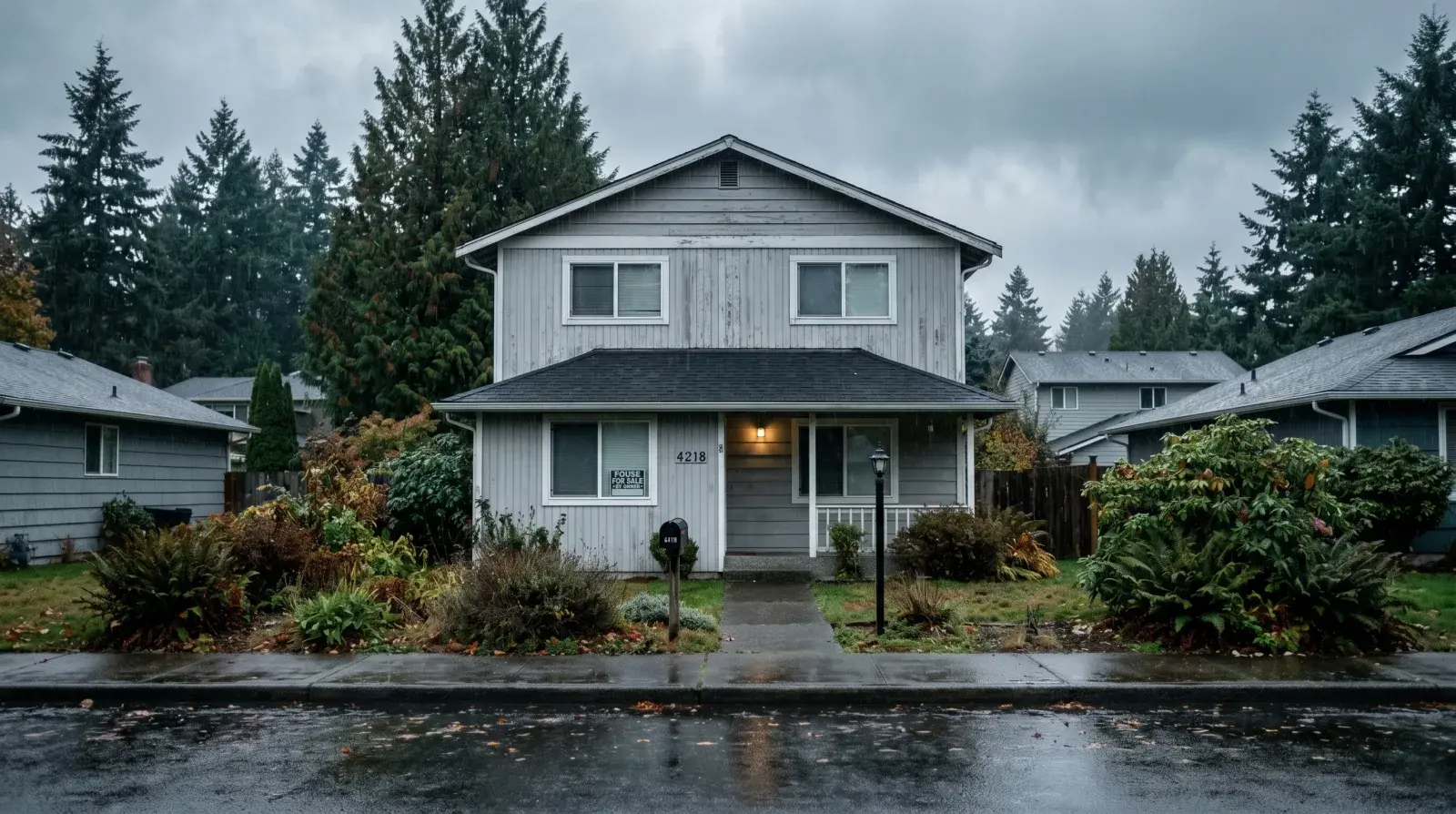
If you owe more on your mortgage than your house is worth in Washington, you can still sell — you just have to deal with the gap between the sale price and the loan payoff. The three realistic paths are bringing cash to closing to cover the shortfall, negotiating a short sale where the lender forgives the difference, or selling to a cash buyer who can combine a fast close with a short-sale negotiation. Which one fits depends on how far underwater you are, whether you're behind on payments, and how much time you have.
This guide explains exactly what an underwater mortgage means, how the Washington short sale process actually works, the major 2026 federal tax change that catches most short-sale sellers off guard, and the specific situations where a cash offer beats a short sale. Everything here is specific to Washington homeowners in Seattle, Tacoma, Spokane, Olympia, and the broader Pacific Northwest.
The short version: Selling underwater means your lender has to be involved, because you can't deliver clear title until the loan is paid or released. Washington's non-recourse rules on most first mortgages cap your downside, but a negotiated short sale doesn't automatically inherit that protection — you need the deficiency waived in writing. And as of January 1, 2026, forgiven short-sale debt is generally taxable. For sellers who are only modestly underwater, a cash sale that closes in days often beats a short sale that drags on for months and leaves a tax bill.
What "Underwater" and "Negative Equity" Actually Mean
An underwater mortgage — also called negative equity — is when you owe more on your home loan than the home would sell for. If your house is worth $480,000 and your mortgage payoff is $530,000, you are $50,000 underwater.
The word that matters is payoff, not balance. Your monthly statement shows a principal balance, but the payoff includes accrued interest, any late fees, and a per-diem interest charge through the closing date. If you're behind on payments, the payoff also includes the arrearages. Always request a formal payoff quote from your servicer before you run any numbers.
Here's how the equity math determines your options:
Most Washington homeowners who find themselves underwater bought near the 2021–2022 price peak with a small down payment, then hit a life event. According to ATTOM Data's home equity reporting, the share of seriously underwater homes nationally has stayed low — well under 5% of mortgaged properties — but the risk concentrates in recent-vintage loans where the buyer put little down and values then softened. In King, Pierce, and Snohomish counties, that's exactly the 2021–2022 cohort.
Can I Sell My House if I Owe More Than It's Worth in Washington?
Yes — but the lender controls the outcome, because the mortgage is a lien against the title.
You cannot legally transfer clear title to a buyer until every lien on the property is paid off or formally released. When the sale price doesn't cover the full payoff, you have to make up the difference one of two ways: pay the gap yourself at closing, or get the lender to accept less than they're owed and release the lien anyway. That second path is a short sale.
There's a third option that confuses people: a cash buyer. A cash buyer doesn't magically erase negative equity — if you're underwater, the buyer still can't pay more than the house is worth. But a cash buyer can close fast enough to matter when you're racing a foreclosure clock, and a signed cash offer is the cleanest thing to put in front of a lender during a short-sale negotiation. We'll come back to this.
> Pro Tip: Don't rely on Zillow or your tax-assessed value to decide whether you're underwater. Pull three to five recent comparable sales within a half-mile, or get a no-obligation cash offer with a real number attached. A 5% error on a $500,000 home is $25,000 — enough to flip you from "slightly underwater" to "fine," or the reverse.
The Washington Short Sale Process, Step by Step
A short sale is a sale for less than you owe, with the lender's written approval to release the lien and (ideally) forgive the shortfall. It is not a do-it-yourself transaction — the lender's loss-mitigation department drives the timeline.
Here is how it typically runs in Washington:
1. Establish the hardship and the shortfall. Lenders approve short sales when the borrower has a genuine hardship (job loss, divorce, medical, relocation) and the home is genuinely worth less than the payoff. You'll document both. 2. Get a buyer and a signed purchase agreement. The lender won't evaluate a hypothetical. You need a real offer in hand — this is where a ready cash buyer speeds everything up. 3. Submit the short-sale package. This includes the hardship letter, financial statements, the purchase agreement, a preliminary HUD-1 / settlement statement, and the listing history. 4. Lender orders a BPO or appraisal. A broker price opinion or appraisal confirms the home's value so the lender knows the offer is fair. 5. Negotiation and approval. The lender either approves, counters, or denies. Approval comes as a written letter that states the price, who pays what, and — critically — whether the deficiency is forgiven. 6. Close. Escrow pays the lender the approved amount, the lien is released, and title transfers.
Per the Washington Department of Licensing's Short Sale Seller Advisory and consumer guidance from Symmes Law Group in Seattle, the full process commonly takes three to six months from listing to closing. That timeline is the single biggest reason short sales fail — buyers walk before the lender responds. A cash buyer who agrees to wait removes that risk.
The Three Consequences of a Short Sale You Have to Plan For
Short sales are sold as a soft landing, and compared to foreclosure they often are. But there are three real costs, and the third one changed in 2026.
1. Credit Damage
A short sale typically drops a credit score, though usually less than a completed foreclosure. According to credit-impact analysis from short-sale specialists, the advantage of a short sale is that it's a cooperative resolution and may involve fewer months of delinquency. Both a short sale and a foreclosure remain on your credit report for seven years. The score recovery is generally faster after a short sale, and conventional mortgage waiting periods to buy again are shorter.
2. The Deficiency — and Whether Washington Protects You
This is where Washington homeowners get the most bad information.
Washington is generally a non-recourse state for purchase-money first mortgages, and RCW 61.24.100 bars deficiency judgments after a completed nonjudicial trustee's sale on a residential deed of trust. That's strong protection — but it applies to a foreclosure, not automatically to a negotiated short sale. A short sale is a contract, and the deficiency-forgiveness has to be written into the lender's approval letter. Second mortgages and HELOCs are a separate negotiation and may retain the right to pursue you.
The rule: never sign a short-sale approval that doesn't explicitly say the debt is satisfied in full and no deficiency will be pursued.
3. The 2026 Tax Bomb — Forgiven Debt Is Now Taxable
This is the most important update in this entire guide.
When a lender forgives debt in a short sale, the IRS generally treats the forgiven amount as cancellation-of-debt income and the lender issues a Form 1099-C. For nearly two decades, the Qualified Principal Residence Indebtedness (QPRI) exclusion — the Mortgage Forgiveness Debt Relief Act provision — let homeowners exclude that forgiven mortgage debt from taxable income.
That exclusion expired on January 1, 2026. Per Nolo's analysis of canceled mortgage debt, only debt forgiven in 2007 through 2025 — or forgiven later under a written agreement entered into before January 1, 2026 — qualifies for the QPRI exclusion. A short sale negotiated and closed in 2026 generally does not.
In plain terms: if your lender forgives $60,000 in a 2026 short sale, that $60,000 can land on your tax return as ordinary income.
There are still escape hatches. The IRS insolvency exclusion lets you exclude forgiven debt up to the amount your total liabilities exceeded your total assets immediately before the cancellation. Debt discharged in bankruptcy is also excluded. But these require documentation and, usually, a CPA. The era of automatic tax-free short sales is over.
Cash Offer vs. Short Sale: A Side-by-Side Comparison
The honest comparison most sellers never see laid out. Picture a table with five rows — speed, credit impact, tax exposure, who controls the timeline, and cash in your pocket — and two columns for a direct cash sale versus a lender-approved short sale.
A cash sale wins on speed (7–14 days), credit (only the missed payments show, if any), and tax simplicity (no 1099-C if the loan is paid in full). It requires that you either have enough value to cover the payoff or can bring the gap to closing.
A short sale wins only when you're so deeply underwater that you genuinely cannot cover the gap. It costs you months, a credit hit, and — in 2026 — a potential tax bill on the forgiven amount.
For a deeper breakdown of how each selling path is priced and where the tradeoffs hide, compare our cash buyer vs. iBuyer vs. realtor guide for Washington. And to understand exactly how a direct buyer arrives at a number, read how cash home offers actually work — the offer math is the same whether or not you're underwater.
If you're weighing your options and the numbers are tight, request a free no-obligation cash offer from Northwest Cash Offers. You'll get a concrete number to compare against your payoff before you commit to anything.
When a Cash Offer Beats a Short Sale (and When It Doesn't)
Here's the decision framework, with no spin.
A cash offer is the better move when:
A short sale is unavoidable (and a cash buyer becomes your best vehicle for it) when:
Even in that second case, the strongest play is a cash offer submitted into a short-sale negotiation. The cash buyer signs immediately, waits out the lender's review without bailing, and closes within days of approval. The lender gets a firm number to evaluate instead of a hope.
This matters because cash buyers handle these situations alongside other distress scenarios constantly. If your underwater situation overlaps with foreclosure, see our guide to selling before foreclosure in Washington. If a bankruptcy filing is in the picture, that interacts directly with the insolvency exclusion. And if there are other liens stacked on the title — an IRS tax lien, delinquent property taxes, or an HOA lien — each one has to be paid or released at closing, which tightens the math even further.
How Do I Sell a House with Negative Equity? A Practical Order of Operations
If you're reading this because the problem is already real, here's what to do this week.
1. Get a payoff quote. Call your servicer and request a full payoff figure — including interest, fees, and any arrearages — good through a future date. The statement balance is not the payoff. 2. Get an honest value. Pull recent comparable sales within a half-mile, or request a direct cash offer for a real number. Skip the automated estimates for a decision this size. 3. Calculate the true gap. Subtract the payoff from a realistic net sale price (after any selling costs). That number tells you which path you're on. 4. Check for other liens. Order a title search or at minimum check the county recorder for second mortgages, tax liens, or judgments. Hidden liens deepen the hole. 5. Talk to a CPA before you accept a short sale. Because of the 2026 QPRI expiration, you need to know your tax exposure and whether the insolvency exclusion covers you before you sign. 6. Pick the highest-value path you have time for. Cover-the-gap cash sale if the gap is small. Cash offer if you're racing a clock. Short sale (ideally via a cash buyer) only if the gap is truly beyond reach.
Do not let the home sit while you avoid the numbers. Every missed payment grows the payoff and shrinks your options.
Local Context: What We See Across the Puget Sound and Eastern Washington
Most underwater situations in the Pacific Northwest trace back to the same root: a 2021–2022 purchase with a small down payment, financed at a low rate, in a neighborhood where values then flattened or dipped while the mortgage balance barely moved.
In the Seattle metro — King, Pierce, and Snohomish counties — the homes are usually in solid condition (Pacific Northwest housing stock holds up well), so the issue is rarely the property. It's the math. In Spokane and the eastern half of the state, lower price points mean the dollar gaps are smaller, but so are the seller's reserves, which makes covering a shortfall harder.
The common thread: sellers who act early, pull real numbers, and get a CPA's read on the 2026 tax picture come out far better than those who wait. A modest gap is survivable. A gap plus a foreclosure plus a surprise tax bill is the outcome we work hard to help people avoid.
Frequently Asked Questions
Can I sell my house if I owe more than it's worth in Washington?
Yes. You can sell a house with an underwater mortgage in Washington, but you have to deal with the shortfall between the sale price and the loan payoff. Your three realistic paths are: bring cash to closing to cover the gap, negotiate a short sale where the lender forgives the difference, or sell to a cash buyer and combine a fast close with a short-sale negotiation. You cannot transfer clear title until every lien is satisfied or released, so the lender has to agree to any sale that doesn't fully pay them off.
Is a cash offer better than a short sale?
It depends on your equity position. If you are only slightly underwater, a cash offer that you top off with a small amount at closing avoids the credit damage, the 1099-C tax bill, and the multi-month approval delay of a short sale. If you are deeply underwater with no savings, a short sale is often unavoidable — but a cash buyer is still the best vehicle for it, because a signed cash offer with a flexible close gives the lender a concrete number to approve and removes financing-fall-through risk. In practice, a cash buyer and a short sale are not either-or; the strongest play is usually a cash offer submitted into a short-sale negotiation.
How do I sell a house with negative equity?
Start by getting two real numbers: a full loan payoff quote from your servicer (not your statement balance) and an honest market value from recent comparable sales or a direct cash offer. Subtract the payoff from the realistic sale price. If the result is positive, you have equity and a normal sale works. If it's negative, you choose between covering the gap with cash, requesting a short sale, or — if you're behind on payments — letting the home go through foreclosure. Washington's non-recourse protection on most first mortgages limits your downside, but a negotiated short sale needs the deficiency waiver in writing.
Does Washington protect me from owing the difference after a short sale?
Partly, and you must confirm it in writing. RCW 61.24.100 bars deficiency judgments after a completed nonjudicial trustee's sale on a residential deed of trust, and Washington is generally a non-recourse state for purchase-money first mortgages. But that statutory protection does not automatically extend to a negotiated short sale, and second mortgages or HELOCs may still pursue you. Always require the lender's short-sale approval letter to state explicitly that the deficiency is forgiven and the debt is satisfied in full.
Will a short sale create a tax bill in 2026?
It can, and this is the single biggest change for 2026. The Qualified Principal Residence Indebtedness exclusion (the Mortgage Forgiveness Debt Relief Act provision) expired on January 1, 2026. Forgiven mortgage debt in a short sale is now generally reported on a Form 1099-C and treated as taxable cancellation-of-debt income, unless a written agreement was entered into before January 1, 2026, or you qualify for another exclusion such as bankruptcy or insolvency. Talk to a CPA before you close — a short sale that forgives $60,000 could put $60,000 of taxable income on your return.
How fast can a cash buyer close on an underwater home in Washington?
A straightforward cash purchase closes in 7 to 14 days because there is no lender, no appraisal contingency, and no financing approval. If the deal requires short-sale approval from your mortgage lender, the close stretches to whatever the lender's review takes — commonly 60 to 120 days — but the cash buyer holds the contract steady the entire time and closes within days of the lender's green light. The buyer pays the payoff directly through escrow, just like any other sale.
The Honest Bottom Line
Being underwater in Washington is a math problem, not a dead end. If the gap between your payoff and your home's value is small, a cash sale where you cover the difference is usually faster, cheaper, and cleaner than a short sale — and it sidesteps the 2026 tax exposure entirely. If the gap is large, a short sale may be unavoidable, and a cash buyer is the most reliable way to get one approved and closed.
What you cannot afford to do is guess at the numbers or assume the old tax-free short-sale rules still apply. They don't. Pull a real payoff quote, get a real value, check the title for other liens, and get a CPA's read before you sign anything.
If you want to know exactly what your home is worth to a direct cash buyer and whether a cash sale could cover or close the gap on your payoff, request a free no-obligation cash offer from Northwest Cash Offers. We'll give you a straight number, walk through the short-sale math if that's where you land, and tell you honestly if a different path serves you better.